

+86-18913642321

Liduck.1985@163.com
DAWANG GEARBOX

Views: 0 Author: Site Editor Publish Time: 2026-01-28 Origin: Site


Stop-start cycles, sudden impacts, overload peaks, and precision indexing are the realities behind many “routine” industrial motions. In these conditions, the best reducer choice is not about being “more advanced” on paper—it is about staying stable, durable, and predictable under a specific load spectrum. That is exactly where a Cycloid Pinwheel Reducer earns its reputation: it is built to handle shock, carry heavy torque in a compact form, and keep repeatable motion performance when the machine is pushed hard. At Dawang Gearbox (Suzhou Dawang Transmission Equipment Co., Ltd., founded in 1998), we produce cycloidal reducers for demanding industrial duty cycles, and this article breaks down the real advantages in an engineer-friendly way so you can judge whether this reducer architecture matches your equipment needs.
Heavy-duty failures often start with concentrated stress: a small contact area takes a large impact, fatigue accelerates, and the weak point grows into a recurring breakdown. A cycloidal reducer addresses this problem through the way it transmits load. Instead of relying on a single gear pair carrying most of the force at one or two contact lines, the cycloidal disc engages a ring of pins or rollers, allowing multiple contact points to share the transmitted load at the same time.
In practical terms, load sharing lowers peak contact stress and reduces the chance that one isolated tooth or one small interface becomes the “first to fail.” That is why cycloidal designs are widely associated with shock tolerance: they are structured to spread force rather than funnel it into a narrow zone. For heavy-duty drives that live through impacts and transient overloads, this architectural difference is often the first advantage engineers notice in the field.
You see the value of shock resistance most clearly in machines where torque is not smooth and continuous. Common examples include indexing tables that repeatedly start, lock, and stop; conveyors that see sudden product accumulation; mixers where viscosity changes create unpredictable load spikes; and reversing motions where the drive repeatedly changes direction under load.
In those scenarios, the reducer is not just reducing speed—it is absorbing the machine’s “bad behavior.” A cycloidal reducer is often used because it stays composed when the operating profile is harsh: it can tolerate impact events, protect uptime, and reduce the frequency of surprise shutdowns caused by shock-related wear or damage.
Oversizing is a common “safe” move when the duty cycle is uncertain: you pick a larger reducer body, reinforce the frame, and accept the cost and weight. The problem is that oversizing creates new issues—space pressure, heavier mounts, and higher inertia. Cycloidal reducers are frequently selected because they can deliver high torque in a relatively compact package, especially when compared with solutions that require extra stages or larger housings to achieve the same output torque.
Compactness is not only a packaging benefit. In many heavy-duty machines, keeping the reducer compact helps maintain a stiffer drivetrain. A shorter, more integrated structure can reduce deflection and improve load handling in real installations where space is limited but torque is not.
When torque density is high, the benefits are tangible for both design and commissioning. A smaller footprint can mean easier integration into existing machine envelopes, less need for structural reinforcement, and cleaner layouts for guards, sensors, and cable routing. It can also simplify retrofits where the old reducer’s space is fixed and your team wants a torque upgrade without redesigning the surrounding structure.
At Dawang Gearbox, this is a common conversation with B2B engineers: the goal is not “small for the sake of small,” but rather compact power that fits real industrial frames without creating new integration headaches.
Many heavy-duty machines are also precision machines. They may lift, index, dose, align, or place components that must land in the same spot cycle after cycle. In these cases, speed reduction alone is not enough—repeatable positioning becomes the true requirement. Backlash becomes important because it affects direction changes, settling behavior, and how reliably a control system can return the load to a known position.
Cycloidal reducers are often discussed as low-backlash-capable designs because their transmission mechanism can be engineered to minimize “play.” That matters when a machine repeatedly reverses, indexes, or makes short moves that rely on tight motion control. The advantage is not theoretical: lower backlash potential can translate into less overshoot, less corrective hunting, and more consistent positioning across long production runs.
Low backlash has obvious value in robotic joints, rotary indexing tables, pick-and-place cycles, and machine tool heads where position repeatability affects product quality. But it also matters in less glamorous equipment: packaging indexing stations, assembly fixtures, print/label positioning mechanisms, and any system where the drive must stop and hold position reliably under load.
If your process depends on repeatable alignment—not just “getting there,” but getting there the same way every time—this advantage becomes a decision driver. A cycloidal reducer is frequently chosen when repeatability is part of the success criteria, not a nice-to-have.
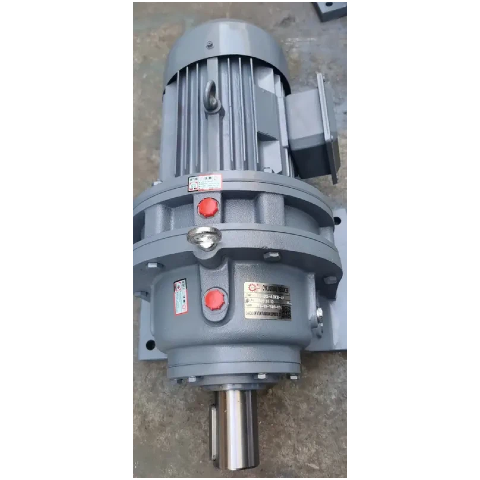
Industrial systems often demand high reduction ratios to reach low output speeds while keeping the motor in an efficient operating region. Achieving high ratios can require multiple stages in conventional gear trains, which can add length, complexity, and interfaces that must be aligned, lubricated, and maintained. Cycloidal reducers can achieve high ratios in compact designs and, in many cases, reduce the need for extra preliminary stages.
Fewer stages can simplify the drivetrain: fewer coupled components, fewer interfaces, fewer alignment points, and less packaging complexity. For design engineers, that can mean cleaner layouts and fewer tolerance stack-ups. For commissioning teams, it can mean fewer surprises during installation because the drivetrain is more integrated.
High ratios are valuable, but heavy-duty operation also brings efficiency and thermal considerations. When output speed is extremely low and torque is high, lubrication behavior and heat management become real topics—not marketing topics, but operating topics. The reducer must run with a lubrication strategy appropriate for the duty cycle, mounting orientation, and ambient conditions.
The correct approach is to treat high ratio as a system-level decision: your motor sizing, cycle profile, thermal environment, and lubrication maintenance planning should be consistent with the load. This is exactly why heavy-duty drives benefit from technical evaluation rather than “ratio-only” selection.
Short-term performance is easy to sell. Long-term stability is what reduces total cost of ownership. In many industrial applications, the hidden cost driver is not the initial backlash number—it is backlash growth over time. When backlash increases, indexing accuracy drifts, positioning repeatability degrades, and equipment needs retuning or mechanical service. That translates into downtime, scrap risk, and maintenance cost.
Cycloidal reducers are often valued in heavy-duty settings because the load-distribution behavior and robust internal structure can support stable performance over long service life. For operations teams, stability is not an abstract concept—it is the difference between predictable maintenance windows and repeated “mystery” troubleshooting cycles.
Long-term stability is supported by disciplined operation and maintenance. Key points include:
Lubrication intervals that match your duty cycle and thermal environment
Sealing that fits your contamination risks, especially in dusty or wet conditions
Installation alignment that avoids unwanted side loads and vibration amplification
Bearing condition monitoring where the drive sees repeated overload events
These are not “how to buy” tips—these are operational practices that protect reducer performance and prevent premature degradation in heavy-duty drives.
Heavy-duty equipment is rarely built on a single standardized frame. Engineering teams need mounting flexibility to fit reducer architecture into different machines and different plant layouts. Cycloidal reducer families commonly support practical integration needs such as horizontal or vertical mounting, flange-type interfaces, and one-stage or two-stage options to match ratio and torque targets.
This flexibility matters because it reduces the number of custom adaptor parts required, and it gives design engineers more freedom to place the drive where it best supports the load path, guarding, and service access.
Commissioning time is not only about wiring and programming—it is also about mechanical fit, alignment, and how quickly the machine reaches stable performance. When mounting options are flexible, teams spend less time redesigning brackets, machining adaptors, or correcting misalignment caused by “forced” geometry. The reducer becomes easier to integrate, and the risk of installation-driven issues drops.
For B2B projects where schedule is tight, this is a practical advantage: flexibility reduces rework and speeds up the path from assembly to stable production.
Advantage of a Cycloid Pinwheel Reducer | The problem it solves | Typical equipment examples |
Load sharing and shock resistance | Failures from impacts and overload peaks | Indexing tables, mixers, stop-start conveyors |
Low backlash potential | Overshoot and poor repeatability | Robotics joints, rotary tables, pick-and-place indexing |
High reduction ratios | Bulky multi-stage gear trains | Compact automation cells, low-speed heavy-duty drives |
Mounting flexibility | Long integration cycles and adaptor complexity | Retrofits, space-limited machines, custom layouts |
The advantages of a Cycloid Pinwheel Reducer are most visible when your load profile is demanding: shock, heavy torque, frequent reversals, and repeatable positioning requirements. In these conditions, the design benefits are practical—load sharing that absorbs impacts, compact torque capability, low backlash potential for stable indexing, and high ratios that keep drivetrains simpler and more integrated. At Dawang Gearbox (Suzhou Dawang Transmission Equipment Co., Ltd.), we manufacture cycloidal reducers for industrial duty cycles, and our Gearbox team can work from your speed, torque, mounting orientation, and shock characteristics to support a configuration match. Contact us and ifmyou are evaluating a shock load resistant gearbox for heavy-duty drives, we are ready to support your project.
When the duty cycle includes strong shock loads, frequent stop-start indexing, or repeated reversals under load—and you also care about stable positioning performance over time.
No. Shock tolerance helps the reducer survive real industrial impacts, but correct torque sizing, proper mounting, and appropriate lubrication still matter for long service life.
Because many heavy-duty systems also require repeatable alignment or indexing. Lower backlash potential can improve repeatability, reduce overshoot, and keep motion performance stable across production cycles.
Maintain correct lubrication intervals, keep seals appropriate for contamination, ensure alignment during installation, and monitor vibration/temperature changes that may signal bearing or lubrication issues.


