

+86-18913642321

Liduck.1985@163.com
DAWANG GEARBOX

Views: 0 Author: Site Editor Publish Time: 2026-02-03 Origin: Site


Most engineers don’t begin with a deep search on gear theory—they begin with a practical question: “Can this reducer survive my machine?” That’s why an application map is often more useful than a principle diagram. A Cycloid Pinwheel Reducer is typically chosen when equipment faces stop-start cycles, reversing loads, impact events, and the need to hold position under torque without losing repeatability. This article is organized the way project teams actually think: we start from load signals, then connect those signals to industries and equipment types, and finally list the machine parameters that help you turn a discussion into a working specification. At Dawang Gearbox (Suzhou Dawang Transmission Equipment Co., Ltd., founded in 1998), we manufacture cycloidal reducers for industrial duty cycles, so the goal here is to help you quickly identify where cycloidal technology is the best match—and where it is simply “not necessary.”
Cycloidal technology tends to show up where motion is not smooth. If your motor starts and stops repeatedly, if the machine reverses direction under load, or if the driven system experiences sudden jams and releases, the reducer sees sharp torque spikes rather than steady torque. Those spikes can create stress concentration in conventional gear meshes, especially when impacts repeat thousands of times per shift.
A cycloidal reducer is commonly used in these cases because its internal load path is built around load sharing. Instead of relying on a single tooth pair to carry the moment, the cycloidal disc engages a ring of pins/rollers across multiple contact points. Practically, that can translate into better survival under shock events, less “surprise damage” from occasional overload, and a more stable drivetrain when the production rhythm is harsh.
Many industrial machines are both heavy-duty and accuracy-driven. Indexing tables, rotary modules, pick-and-place stations, and tool positioning systems must stop on target and hold position—while torque is still present at the output. That is where low backlash potential and high rigidity become meaningful.
Cycloidal reducers are frequently used in positioning systems because the mechanism can be engineered for tight motion control characteristics. When repeatability matters, you are not just concerned about the ratio; you care about whether the output returns to the same angle after thousands of start-stop cycles, and whether direction changes cause drift or overshoot. If your process includes “positioning under load,” that’s one of the clearest signals that cycloidal technology may fit.
Conveyors look simple, but they can be brutal for gearboxes. Even “continuous” conveyor lines often operate with frequent starts and stops: zones release product, accumulation builds, photoelectric controls trigger short runs, and the line repeatedly cycles between idle and motion. When product piles up or a transfer point jams, the drive sees short-duration overload. When the jam clears, the system rebounds and can shock the drivetrain again.
This load pattern punishes weak points—especially if the reducer was selected only by nominal torque and not by peak torque and duty cycle. Heat, vibration, and backlash growth can appear early if the reducer is constantly asked to absorb events it was never designed to handle.
Cycloidal reducers commonly appear in heavy-duty conveying and transfer equipment where the line must keep running despite unpredictable load events. Typical examples include:
Warehouse and distribution conveying where accumulation and release cycles are frequent
Heavy transfer conveyors where pallets or bins introduce impact loads
Stop-start conveying lines that demand repeatable indexing at certain stations
Systems where the plant wants durability under jams without oversizing the entire drivetrain
For project teams, the advantage is often practical: cycloidal technology can provide a robust reduction solution that suits real conveyor behavior, not an idealized steady-load assumption.
Modern automation cells often combine compact layouts with high output torque requirements. Robotic joints, rotary actuators, indexing modules, and servo-driven positioning axes must deliver repeatable motion while staying stiff enough to resist external forces. Even when payloads are not “heavy industry” heavy, the torque at a joint can still be high due to lever arms, acceleration demands, and rapid direction changes.
Cycloidal reducers are frequently used in these modules because they can deliver high torque in a compact body and support repeatable positioning behavior. For integrators, this can simplify cell design: compact reducers reduce envelope pressure, while robust load handling helps keep motion stable across cycles.
Automation teams sometimes compare cycloidal designs with strain wave drives because both are used in precision motion. The most useful way to discuss the difference is by application conditions rather than brand preference. Strain wave solutions are often valued when extremely compact, ultra-low backlash behavior is needed at relatively controlled loads, while cycloidal solutions are often chosen when torque, shock tolerance, and long-term robustness under industrial duty cycles are priorities.
If your automation module faces impacts, repeated reversals, or higher shock factors—especially in production environments where loading is not perfectly predictable—cycloidal architecture often becomes the more practical fit.
Machining accuracy is not only a matter of CNC code and spindle quality. The drivetrain feeding rotary tables, indexing heads, and tool change systems can influence surface finish, positioning accuracy, and repeatability over long runs. Stiffness helps prevent micro-movement under cutting forces, and stable vibration behavior helps prevent quality drift that shows up as chatter marks or inconsistent tolerances.
In these environments, the reducer is part of the accuracy chain. A reduction system that remains stable under torque—especially in indexing and hold-position tasks—can help keep machining results consistent.
Cycloidal reducers tend to appear in machine tool subsystems that have recognizable motion patterns:
Low-speed, high-torque holding where the axis must stay locked under load
Indexing moves that repeat continuously with tight angular targets
Start-stop positioning where the system must settle quickly and predictably
Rotary tables where the reducer must combine compactness with stiffness
When your equipment needs both “muscle” and “control,” cycloidal technology often becomes a strong candidate for the drive architecture.
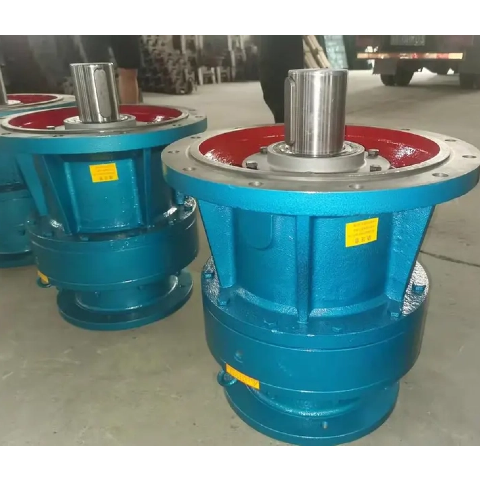
High-throughput production equipment—especially packaging—works at speed, and small errors accumulate fast. A minor overshoot in a rotary motion may not look dramatic in one cycle, but across thousands of cycles it becomes scrap, rework, or jams downstream. Packaging lines often require synchronized motion: indexing, sealing, cutting, labeling, and product handling all depend on timing and repeatable stops.
In these machines, the reducer is often selected not only for torque, but for stable stop-start performance. Cycloidal reducers can be used where durability and repeatability must coexist, especially at stations that repeatedly index or hold position under load.
Printing-related equipment is sensitive to motion smoothness and consistency. Vibration, speed ripple, or unstable holding can translate into quality issues, misregistration, or variation that becomes visible on the product. While printing systems vary widely, the common requirement is stable, repeatable motion—often under continuous production pressure.
Cycloidal reducers are often listed among solutions used in printing presses and related production lines because they can provide robust reduction and stable behavior where consistency is tied directly to output quality.
Some environments convert “nice-to-have reliability” into a hard KPI. Mining, energy, heavy lifting, and other harsh-duty sectors often combine high torque with contamination risks, vibration, temperature variation, and demanding service expectations. The reducer in these systems must survive load events that are simply part of daily operation—impact, overload peaks, and continuous stress.
In these industries, cycloidal reducers are often used where the drivetrain must carry high torque and tolerate shock while remaining serviceable over time. The selection is rarely about theoretical efficiency; it is about staying alive under real load.
Project teams in harsh environments typically validate the reducer against operating reality, not brochure assumptions. Common validation topics include:
Peak torque and overload scenarios, including safety factor requirements
Sealing and protection strategy matched to dust, moisture, and contamination exposure
Lubrication strategy matched to mounting orientation and thermal conditions
Installation alignment and structural support to prevent unintended side loads
Duty cycle definition: continuous load, intermittent peaks, and impact frequency
These checks keep the evaluation grounded in how the machine will actually run.
Industry / equipment | Common load pattern | Why a Cycloid Pinwheel Reducer fits |
Stop-start conveyors | Frequent start/stop plus jams and accumulation | Shock tolerance and durability under load events |
Robotics joints | Precision positioning under torque and reversals | Repeatable positioning behavior and compact torque delivery |
CNC rotary tables | Indexing plus stiffness demand | Stable hold under torque and consistent indexing motion |
Printing/packaging lines | High cycles plus repeatability | Reliable stop-start performance and stable motion quality |
Mining/heavy machinery | High torque and harsh duty | Load sharing and long-life performance in demanding cycles |
Modern industry rarely asks a reducer to do one simple job. The most “cycloidal” applications share a familiar pattern: stop-start impact, heavy load, repeatable positioning under torque, and tight space where compact power matters. That is why you see cycloidal technology across conveyors, automation cells, rotary positioning systems, packaging/printing equipment, and harsh-duty heavy industry. At Dawang Gearbox (Suzhou Dawang Transmission Equipment Co., Ltd.), we manufacture cycloidal reducers for industrial duty cycles, and our Gearbox team can work from your machine data to confirm reduction ratio, stage count, and mounting orientation such as horizontal/vertical and flange layouts. Contact us and learn more.
Look for the load signals: frequent starts/stops, reversing under load, impact events from jams or indexing, and a requirement to hold position accurately under torque. If several of these are true, cycloidal architecture is usually worth evaluating.
No. They are used in heavy industry, but also in industrial automation, robotics modules, rotary tables, packaging, and production equipment where repeatability and shock tolerance are important.
Prepare output torque and peak torque, target speeds, duty cycle and reversals, shock factor, mounting orientation, and environmental conditions such as dust, moisture, and temperature.
Many project teams also search for a high torque low speed reducer when they are evaluating where a Cycloid Pinwheel Reducer fits across industries and equipment types.


