

+86-18913642321

Liduck.1985@163.com
DAWANG GEARBOX

Views: 0 Author: Site Editor Publish Time: 2026-01-27 Origin: Site


Real production environments punish ordinary drives: heavy shock loads, frequent starts and stops, and the need to hold position accurately at very low speed while pushing high torque. When an engineer needs dependable reduction for indexing, conveying, mixing, or automation where impact and repeatability matter, the Cycloid Pinwheel Reducer is a proven solution because it uses a planetary-style transmission concept combined with cycloid pin-tooth meshing rather than a typical involute gear mesh. At Dawang Gearbox (Suzhou Dawang Transmission Equipment Co., Ltd., founded in 1998), we manufacture cycloidal reducers for industrial duty cycles, and this article explains the mechanism in plain English—how it works, what parts you’ll see, how ratios and stages are understood, and how it compares with other common reducer types.
A cycloidal reducer does not reduce speed by two involute gears rolling through a classic tooth profile. Instead, an eccentric input generates a controlled wobble motion that drives a cycloidal disc. That disc has lobes around its edge, and those lobes engage a fixed ring of pins or rollers. As the disc wobbles, many contact points share load across the pin ring, and the disc’s net rotation becomes much slower than the input—creating reduction and torque multiplication in a compact structure.
Inside the reducer, the ring of pins/rollers forms a circular “pinwheel.” The cycloidal disc engages this ring as it moves. The name is useful because it matches what you can visualize: a lobed disc moving against a wheel made of pins, transferring load through repeated multi-point contact rather than a single gear pair carrying most of the force.
The input shaft carries an eccentric element supported by an eccentric bearing. When the input rotates, it forces the cycloidal disc to travel in an offset circular path. This wobble is not random; it is guided by the disc’s engagement with the surrounding pins, which constrains the motion and converts it into a predictable reduction process.
As the disc wobbles, its lobes press against multiple pins/rollers in the fixed ring. Because the pin ring does not rotate, the disc experiences a slow rotation in the opposite direction relative to the eccentric input. This “opposite-direction” rotation is the heart of cycloidal reduction: each input revolution advances the engagement pattern by a small increment, resulting in a large speed drop at the disc’s net rotation.
Near the center of the disc, there are holes through which output pins/rollers pass. Those pins connect to the output flange or shaft. When the disc rotates slowly, it drives the output pins, delivering reduced speed and amplified torque to the load. This transfer stage is straightforward in concept: perimeter engagement creates reduction, and the output pins deliver that reduced motion to the output member.
A typical unit contains one cycloidal disc (one-stage) or two discs (two-stage), plus a ring of pins/rollers mounted in the housing. The disc perimeter and pins form the primary load-carrying interface. In industrial applications, the design focus is clear: stable geometry, controlled contact surfaces, and a housing that holds alignment under load. The advantage of this architecture is that load can be distributed across multiple pins during operation, which supports high torque and resilience in demanding duty cycles.
Cycloidal reducers depend heavily on bearing support and housing rigidity. Bearings keep the eccentric motion stable and maintain alignment of rotating elements under torque. Housing rigidity helps prevent distortion that could affect contact distribution between the disc and pins. Industrial users typically evaluate configuration signals such as housing construction, bearing options, and process control standards. Dawang Gearbox operates large-scale manufacturing and precision-controlled production to support reliable consistency in these critical interfaces.
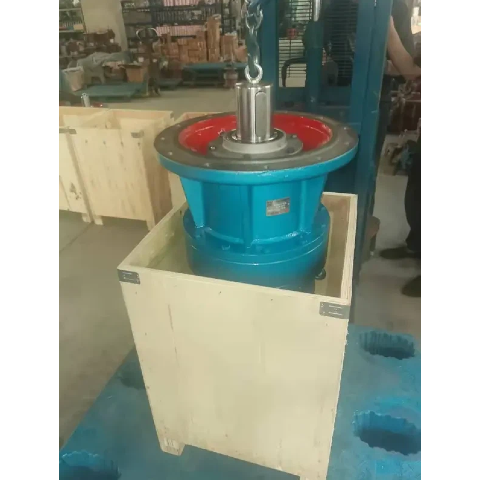
Cycloid reducers appear in many layouts—horizontal or vertical mounting—depending on machine arrangement. Flange mounting is common for automation integration because it is compact and convenient for direct connection to equipment frames or driven components. Foot mounting also appears in heavier industrial setups where structural support and maintenance access are important. In practice, the mounting style should match both mechanical layout and the load path of the driven machine.
Cycloidal reduction is closely tied to the relationship between the number of lobes on the disc and the number of pins in the ring. A practical way to think about it is “one small step per revolution”: each input turn advances the engagement pattern by a small difference, and that difference accumulates into slow net output rotation. This intuitive lobe-versus-pin idea helps engineers understand why cycloidal designs can achieve large reduction ratios in compact size.
One-stage units cover many industrial needs where you want strong torque at low speed with a compact footprint. Two-stage units stack reduction to reach much higher ratios when very low output speed is required or when torque demands are extreme. In real projects, multi-stage becomes attractive when a single integrated reducer is preferred over adding extra external stages, and when the machine needs stable slow motion without oversizing the drive system.
In factory automation and heavy-duty machinery, ratio availability influences motor selection, output speed targets, and overall drive design. Cycloidal product families typically cover a wide ratio spectrum, allowing engineers to match speed and torque requirements without complicated multi-component transmission arrangements. This flexibility is one reason cycloidal reducers remain popular across different industries and machine types.
Backlash is the “play” observed when changing direction—how much movement occurs before torque transfers to the output. Hysteresis is broader “lost motion” behavior that includes compliance, micro-deformation, and load-dependent effects that appear during reversals or varying torque. Industrial buyers care because repeatable positioning depends on more than a single number. Cycloidal designs are often used in applications where low backlash performance is valued, but actual motion quality depends on the reducer’s structural stiffness, assembly precision, and the real load conditions.
Torque density refers to how much torque you can obtain for a given reducer size. Cycloidal designs are frequently selected where compactness and high torque must coexist. Rigidity matters because it influences how stable the output is under load, especially in indexing and positioning tasks. Vibration behavior matters because harsh duty cycles expose any weakness in stiffness or internal support. For many industrial users, cycloidal architecture offers a balanced combination of compact torque, robust load handling, and stable motion characteristics.
Different reducer types serve different priorities. Cycloidal reducers often fit when shock loads and repeatability are central concerns and when high torque is needed in a compact design. Planetary gearboxes often fit broad automation use cases where efficiency and standardized integration are key. Worm gearboxes often appear in simpler systems where cost-focused decisions and moderate duty cycles dominate.
Table — Reducer type snapshot for industrial users
Feature that matters | Cycloid Pinwheel Reducer | Planetary gearbox | Worm gearbox |
Backlash potential | Very low (design-dependent) | Low–moderate | Often higher (varies) |
Shock load tolerance | Strong via load distribution | Moderate | Moderate |
Typical ratio per stage | High ratios possible | Moderate | Moderate–high |
Best-fit scenarios | Precision + heavy duty | General automation | Simple, cost-focused drives |
A Cycloid Pinwheel Reducer turns high-speed input into slow, powerful output by combining eccentric-driven cycloidal motion with multi-point pin engagement, creating a reduction mechanism suited for industrial shock loads, compact torque, and repeatable low-speed operation. At Dawang Gearbox (Suzhou Dawang Transmission Equipment Co., Ltd.), we build cycloidal reducers for real duty cycles and configuration needs—if you share your required torque, target output speed, and mounting constraints, our Gearbox team can support configuration matching and application discussion. Contact us and we’re ready to help you move from concept to a workable drive solution.
Its cycloidal disc and pin engagement can distribute load across multiple contact points, supporting high torque and strong tolerance to shock loads in industrial duty cycles.
Yes, it is commonly used where low backlash and stable low-speed motion are important, especially in indexing, automation, and repeatable positioning tasks.
Choose two-stage when you need much higher reduction ratios, extremely low output speed, or very high torque within a compact integrated reducer design.
Cycloidal is often preferred for shock tolerance and heavy-duty precision; planetary is a strong general automation choice; worm is commonly used for simpler, cost-focused drives where efficiency and precision may be less critical.


