

+86-18913642321

Liduck.1985@163.com
DAWANG GEARBOX

Views: 442 Author: Site Editor Publish Time: 2026-02-22 Origin: Site


The heart of any plastic extrusion line isn't just the screw or the motor; it is the Extruder Gearbox. This critical component acts as the bridge between raw power and controlled output. In high-demand manufacturing environments, achieving the perfect balance of speed and torque determines whether a product meets quality standards or ends up in the scrap bin.
In this guide, we will explore how a high-quality Extruder Gearbox directly impacts the efficiency and precision of your production line. We will dive into the technical mechanics, the importance of Precision engineering, and why choosing the right Heavy Duty gear system is a game-changer for your ROI.
An Extruder Gearbox is more than a simple speed reducer. It takes the high-speed, low-torque output from an electric motor and transforms it into the low-speed, high-torque force required to turn a viscous polymer melt. Without this conversion, the screw could not overcome the massive resistance of the plastic material inside the barrel.
Efficiency begins here. If the gearbox loses too much energy through friction or heat, the entire production line suffers. Modern Single Screw Extruder Gearboxes are designed with optimized gear geometry to ensure that over 98% of the motor's power reaches the screw. This minimization of energy loss reduces operational costs and prevents the motor from overheating under heavy loads.
Torque density refers to the amount of torque a gearbox can handle relative to its size. A High Torque Extruder Gearbox allows manufacturers to use smaller footprints while processing tougher materials like recycled HDPE or filled polymers. This capability ensures that the production line maintains a steady flow even when material viscosity fluctuates, which is the first step toward true process Precision.
Precision in plastic extrusion is measured by the consistency of the output. If the screw flickers in its rotation speed by even a fraction of a percent, the wall thickness of a pipe or the gauge of a film will vary. A high-end Extruder Gearbox eliminates these fluctuations.
By using ground helical gears with high accuracy grades (often DIN 3 or 4), these gearboxes ensure smooth power delivery. Unlike lower-quality gears that may have "backlash" or microscopic gaps between teeth, a Precision gearbox maintains constant contact. This prevents "surging," a common issue where the plastic melt exits the die in uneven pulses.
| Feature | Impact on Precision | Benefit to Manufacturer |
| Ground Helical Gears | Reduces vibration and noise | Longer component life |
| Low Backlash Design | Steady screw RPM | Uniform product dimensions |
| Integrated Sensors | Real-time monitoring | Predictive maintenance |
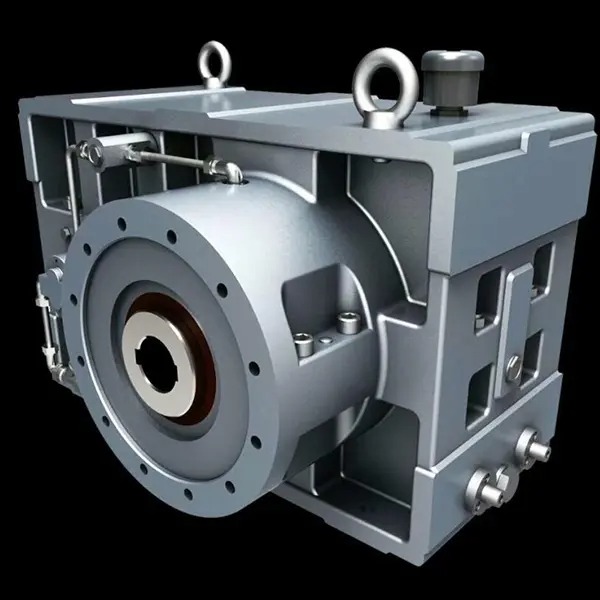
Plastic extrusion generates an incredible amount of "push back." As the screw pushes the melted plastic forward through the die, the plastic pushes the screw backward with equal force. This is known as axial thrust. If this force reaches the internal gears of the gearbox, it will destroy them in hours.
This is why a robust Extruder Gearbox with Thrust Bearing is non-negotiable. The Thrust Bearing (often a spherical roller type or a tandem bearing arrangement) is housed in a dedicated section of the gearbox to absorb these massive longitudinal forces.
Many industry-standard gearboxes, such as those found atDW Gearbox, utilize a specialized thrust housing.
Protection: It isolates the gears from axial stress.
Durability: It uses high-capacity bearings that can handle thousands of hours of continuous operation.
Cooling: These housings often include dedicated oil cooling paths to prevent the bearing from seizing under high pressure.
The physical layout of your production line impacts your facility's efficiency. Depending on your space constraints and the type of product you make (e.g., blown film vs. sheet extrusion), the orientation of your Extruder Gearbox matters.
A Vertical Extruder Gearbox is often used in space-constrained environments or specific applications like vertical blowing machines.
Space Saving: It allows the motor to be mounted vertically, reducing the machine's footprint.
Gravity-Assisted Lubrication: In some designs, the vertical arrangement helps ensure that the top bearings stay lubricated through an internal pump system.
For most large-scale pipe and profile extrusions, a horizontal Heavy Duty Extruder Gearbox is the standard. These units are built for maximum stability and ease of maintenance. They provide a lower center of gravity, which reduces vibration—a key factor in maintaining Precision at high output rates.
Efficiency isn't just about movement; it’s about heat. An Extruder Gearbox generates internal heat due to gear meshing and bearing friction. If this heat isn't managed, the lubricating oil thins out, leading to premature wear and "thermal runaway."
High-performance Extruder Gearboxes incorporate sophisticated cooling systems:
Internal Cooling Coils: Copper or stainless steel tubes that circulate water through the oil reservoir.
External Heat Exchangers: For High Torque applications, oil is pumped out of the gearbox, through a fan-cooled or water-cooled exchanger, and back in.
Forced Lubrication: This ensures that every gear tooth and bearing receives a fresh, cool supply of oil, regardless of the operating speed.
By keeping the temperature stable, we ensure the oil maintains its viscosity. This protects the Precision components and allows the line to run 24/7 without stopping for "cool-down" periods.
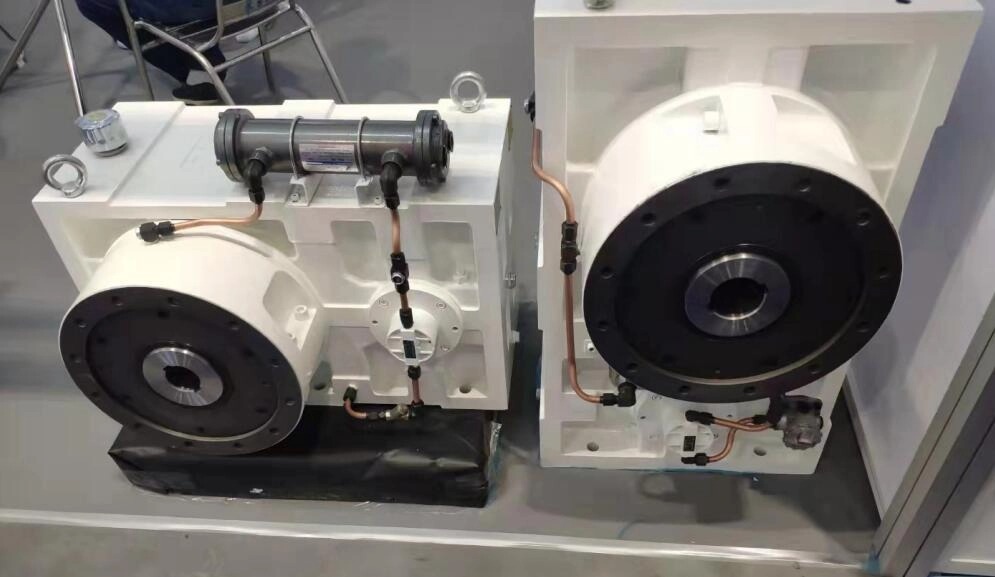
While twin-screw systems have their place, the Single Screw Extruder Gearbox remains the primary choice for the vast majority of plastic products, from trash bags to medical tubing. Its simplicity is its strength, but that simplicity requires a gearbox that can handle a wide range of polymers.
A well-designed Single Screw gearbox must be adaptable. Whether you are processing LDPE, PVC, or PP, the gearbox must provide the torque required for different melt temperatures.
High Torque at Low Speeds: Essential for heat-sensitive materials like PVC.
High Speed Stability: Necessary for high-output polyolefin lines.
We see that by using a Heavy Duty gear arrangement, manufacturers can switch between different materials without fearing for the gearbox's structural integrity. This versatility is a direct boost to plant efficiency, as it reduces the need for multiple specialized machines.
What makes a gearbox "Heavy Duty"? It starts with the metallurgy. The gears inside a quality Extruder Gearbox are usually made from high-strength alloy steel (like 20CrMnTi).
To achieve the necessary hardness, the gears undergo a process called carburizing. This creates a diamond-hard outer "case" to resist wear, while the "core" remains tough and ductile to absorb shocks.
Surface Hardness: HRC 58-62.
Result: The gears can withstand millions of cycles without pitting or chipping.
When we talk about Precision, we are also talking about the housing. A rigid, cast-iron housing (like HT200 or ductile iron) ensures that the shafts stay perfectly aligned even when the gearbox is under maximum load. If the housing flexes, the gears misalign, efficiency drops, and the unit eventually fails.
To maintain the efficiency and Precision of your Extruder Gearbox, a proactive maintenance strategy is essential. Modern production lines are moving toward "Industry 4.0," where the gearbox is no longer a "black box" but a data-providing component.
Oil Analysis: Regularly checking for metal shavings can alert you to bearing wear before a catastrophic failure occurs.
Vibration Monitoring: Excessive vibration is a leading indicator of misalignment or gear damage.
Temperature Checks: Sensors should monitor both the oil sump and the Thrust Bearing housing.
By implementing these steps, you ensure that your Extruder Gearbox remains a reliable asset for decades, rather than a bottleneck that causes expensive downtime.
The Extruder Gearbox is the silent partner in every successful plastic production facility. By choosing a unit that prioritizes High Torque capacity, incorporates a robust Thrust Bearing, and utilizes Precision ground gears, you are investing in the long-term health of your production line. Whether you require a Single Screw or a Vertical configuration, the goal remains the same: transforming raw energy into perfect plastic products with minimal waste.
High-quality engineering doesn't just save power; it provides the stability needed to push your machinery to its limits safely. If you want to improve your line's output quality and reduce energy costs, start by looking at the gearbox.
Q1: How often should I change the oil in my Extruder Gearbox?
For a new Extruder Gearbox, the first oil change should occur after roughly 500 hours of "run-in" time. After that, standard mineral oil should be changed every 2,500 to 3,000 hours, while synthetic oils can last up to 5,000 hours depending on operating temperatures.
Q2: Why is my gearbox vibrating more than usual?
Vibration in a Heavy Duty gearbox usually stems from three issues: misalignment between the motor and gearbox, worn-out bearings, or an unstable machine foundation. Check your couplings and the Thrust Bearing first.
Q3: Can I upgrade my existing line with a High Torque Extruder Gearbox?
Yes, in many cases. However, you must ensure that your motor and the extruder screw can handle the increased torque. Upgrading to a Precision gearbox often allows for higher output speeds without sacrificing product quality.
Q4: What is the benefit of a gearbox with an integrated oil pump?
An integrated pump ensures "forced lubrication." Unlike "splash lubrication," which relies on gears dipping into an oil bath, forced lubrication sprays oil directly onto the gear teeth and into the bearings. This is essential for Vertical units and high-speed operations.


