

+86-18913642321

Liduck.1985@163.com
DAWANG GEARBOX

Views: 251 Author: Site Editor Publish Time: 2026-02-18 Origin: Site


Selecting the right extruder gearbox is the most critical decision you will make for your plastic production line. It acts as the heart of the machine, converting motor power into the steady, high-torque rotation required to melt and push polymer through a die. If the gearbox fails, the entire line stops.
This guide focuses on the technical essentials. We will skip the fluff and dive straight into the engineering features that separate a heavy duty extruder gearbox from a standard industrial unit. Whether you are upgrading a single screw extruder gearbox or designing a new system, understanding these key features ensures long-term reliability and energy efficiency.
In plastic extrusion, torque is everything. The extruder gearbox must handle immense resistance as the screw pushes viscous plastic forward. Torque density refers to the amount of output torque a gearbox can deliver relative to its physical size.
Modern machinery demands a high torque extruder gearbox that occupies a small footprint. When we look at high-performance units, we focus on the gear geometry. High-quality gears use ground helical teeth to maximize the contact area. This design allows the unit to transmit more power without increasing the heat signature.
To achieve high torque density, manufacturers use vacuum-carburizing heat treatments. This process hardens the gear surface while keeping the core tough. It prevents teeth from snapping under sudden pressure spikes. If your process involves recycled plastics or high-viscosity resins, a precision extruder gearbox with a high service factor is non-negotiable. It ensures that the internal components don't succumb to fatigue after just a few months of 24/7 operation.
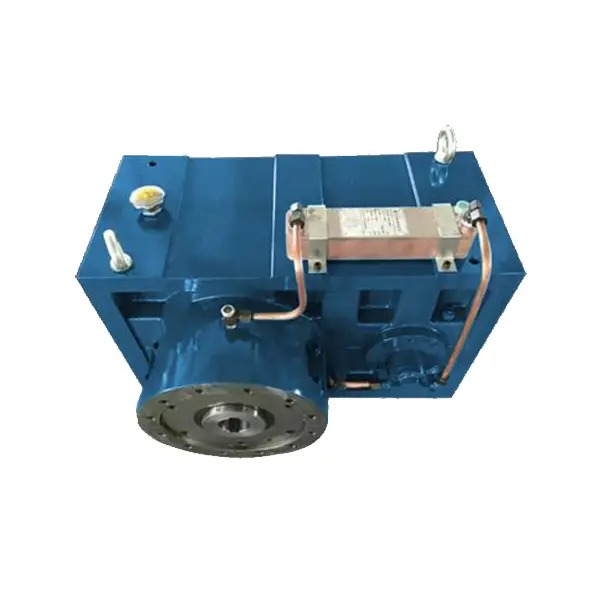
The extrusion process generates a massive "push back" force as the screw forces material through the die. This axial load would crush a standard industrial gearbox. Therefore, a specialized extruder gearbox with thrust bearing is essential.
The thrust bearing housing is usually located at the front of the gearbox. It absorbs the backpressure from the screw, protecting the internal reduction gears from axial stress. We categorize these bearings based on their load capacity and life expectancy ($L_{10}$ life).
| Bearing Type | Load Capacity | Suitability |
| Tapered Roller | High | Standard single screw extruder gearbox setups. |
| Tandem Thrust | Extremely High | High-pressure, small-diameter applications. |
| Spherical Roller | Moderate/High | Systems with potential shaft misalignment. |
We recommend choosing a housing design that allows for easy bearing inspection. A heavy duty extruder gearbox often features a separate thrust chamber. This design ensures that if a bearing fails, metal debris doesn't enter the main gear lubrication circuit, saving you from a total system rebuild.
Your choice of extruder gearbox depends entirely on your screw configuration. While they share some DNA, their internal mechanics serve different purposes.
The single screw extruder gearbox is the workhorse of the pipe, profile, and sheet industry. It is valued for its simplicity and durability. These units typically feature a parallel shaft or vertical extruder gearbox orientation. Because there is only one output shaft, the internal design is spacious, allowing for massive, robust gears that can run for decades with basic maintenance.
In contrast, twin-screw gearboxes (specifically co-rotating) are engineering marvels. They must distribute high torque to two shafts that sit very close together. This requires a "torque-split" design. While we focus primarily on the single screw market in this guide, it is important to note that the precision required for twin-screw setups is significantly higher.
Regardless of the type, ensure the output shaft splines match your screw exactly. A loose fit here will lead to fretting corrosion and eventual shaft breakage.
Heat is the primary enemy of a heavy duty extruder gearbox. Plastic extrusion runs at high temperatures, and the gearbox itself generates heat through friction. Without a dedicated cooling system, the lubricating oil will thin out, leading to metal-on-metal contact.
Splash Lubrication: Common in smaller, low-speed units. The gears dip into an oil bath. It is simple but limited in heat dissipation.
Forced Lubrication: Essential for any high torque extruder gearbox. A pump circulates oil through a heat exchanger (water or air-cooled) and sprays it directly onto the gear teeth and bearings.
We often see failures when operators ignore the oil filter. A precision extruder gearbox should include a visual pressure gauge and a flow switch. These sensors can trigger an emergency stop if the oil flow drops, protecting your investment from a catastrophic "melt-down."
Space constraints on the factory floor often dictate the physical layout of the extruder gearbox. You must choose between a standard horizontal unit and a vertical extruder gearbox.
The vertical extruder gearbox is frequently used in blown film lines or applications where the motor is mounted above or below the screw. This saves significant floor space. However, vertical units present unique lubrication challenges. The top bearings are often "high and dry," away from the oil sump. We must ensure these units have a reliable internal pump to lift oil to the uppermost components.
Horizontal units are generally easier to maintain. Gravity keeps the oil where it needs to be, and all components are accessible at waist height. If your facility has the room, a horizontal heavy duty extruder gearbox is usually the most cost-effective and reliable choice for long-term service.
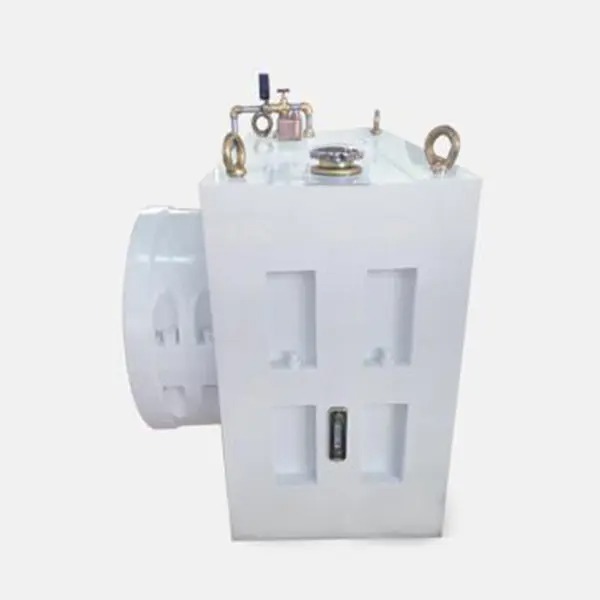
A precision extruder gearbox is only as good as the metal inside it. High-tier manufacturers adhere to strict standards, such as AGMA (American Gear Manufacturers Association) or DIN (German Institute for Standardization).
Most heavy duty extruder gearbox components are forged from 20CrNi2Mo or 18CrNiMo7-6 alloy steel. These materials offer the perfect balance of surface hardness and core flexibility.
Grinding: Gears should be ground to a high precision grade (typically DIN 5 or 6). This reduces noise and vibration.
Housing: Look for a housing made of high-strength ductile iron (QT500 or similar). It absorbs vibration better than standard grey iron, which keeps the extruder gearbox quiet and stable.
Low-quality gearboxes often use "as-cast" gears or lower-grade alloys. These might work for a few months, but under the relentless pressure of a single screw extruder, they will eventually develop "pitting"—small craters on the gear teeth that lead to total failure.
In a modern factory, noise pollution is a safety concern. A noisy extruder gearbox is also a sign of inefficiency. Vibration indicates that the gears are not meshing perfectly, or the shafts are slightly misaligned.
To minimize noise, we look for:
High-Quality Bearings: Using brands like SKF, FAG, or NSK ensures the shafts stay perfectly centered.
Case Rigidity: A thick-walled housing prevents the "echo chamber" effect.
Balanced Rotors: All high-speed shafts must be dynamically balanced.
A quiet single screw extruder gearbox typically operates below 75-80 dB(A). If you hear a high-pitched whine or a rhythmic thumping, it usually points to a gear tooth error or a bearing race defect. Regular vibration analysis can catch these issues before they cause a shutdown.
Selection isn't just about the first day of operation; it's about the tenth year. A well-designed heavy duty extruder gearbox includes features that make life easier for your maintenance team.
Oil Level Sight Glass: You should be able to check oil levels at a glance without stopping the machine.
Magnetic Drain Plugs: These catch small metal particles, acting as an early warning system for internal wear.
Accessible Seals: Input and output seals will eventually wear out. A design that allows for seal replacement without stripping the entire extruder gearbox is a massive advantage.
Breather Filters: Extrusion environments are often dusty. A high-quality desiccant breather prevents moisture and dust from entering the oil sumps.
By choosing an extruder gearbox with these features, you reduce the "Mean Time To Repair" (MTTR), keeping your production uptime as high as possible.
Selecting an extruder gearbox requires a deep look at torque density, thrust load capacity, and thermal management. A high torque extruder gearbox might have a higher upfront cost, but it pays for itself through energy efficiency and reduced downtime. Focus on the integration of a thrust bearing, the quality of the gear grinding, and the reliability of the lubrication system. Whether you need a vertical extruder gearbox for a compact line or a heavy duty extruder gearbox for high-volume production, prioritizing precision and material quality will ensure your plastic extrusion machinery runs smoothly for years to come.
1.What is the typical lifespan of a high-quality extruder gearbox?
With proper lubrication and maintenance, a heavy duty extruder gearbox can last 10 to 15 years in a 24/7 production environment. The bearings are usually the first components that need replacement.
2.Can I use a standard industrial gearbox for my extruder?
No. Standard gearboxes are not designed to handle the massive axial thrust generated by the extrusion screw. You specifically need an extruder gearbox with thrust bearing to prevent the internal gears from being crushed.
3.How often should I change the oil in my single screw extruder gearbox?
For a new unit, we recommend the first oil change after 500 hours of "run-in." After that, every 4,000 to 6,000 hours is standard, depending on the oil type (synthetic vs. mineral) and the operating temperature.
4.Why is my extruder gearbox overheating?
Common causes include a clogged oil cooler, overfilling the oil sump, or a failing bearing. If the extruder gearbox is undersized for the required torque, it will also generate excessive heat.
5.What information do I need to provide to get a quote for a new gearbox?
You should know your motor power (kW/HP), input speed (RPM), required output speed, the diameter of the screw, and the maximum melt pressure of your process.


